10 Misused French Terms in the English Language – Part 3
10 Misused French terms that don’t actually mean the same in French. Check out the 3rd post in this 3-part series. Kindly check website for more details.
On this page
1. passé2. pièce de résistance (piece de resistance)3. première4. Omelette du fromage5. rendezvous6. résumé7. risqué (also risque)8. séance9. touché10. vignetteThe English language has borrowed a lot of words and phrases from the French language.
But over time, some of these words have evolved and are now used in a completely different way from the original French usage. Most English speakers however, still consider these as “actual” French terms even if they may not be recognized as such by the French.
This article (and the previous two articles in this series) looks at French words and phrases whose meanings, spelling or usual context can differ in English. Some also share meanings in both languages, so context matters.
To avoid any confusion when conversing with French speakers, check out these additional 10 terms with different meanings in French.
1. passé
Whether written with accent marks or without, this term appears regularly in English speakers’ conversations to mean something or someone that’s ‘out of style’, unfashionable, or past its prime. Here’s the Urban Dictionary definition of passé:
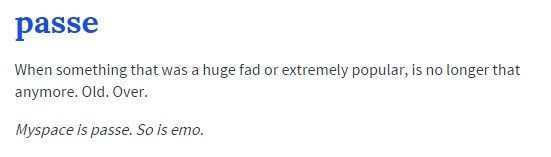
In French, passé can mean “past” or refer to something past its best. To clearly say “out of fashion”, use passé de mode.
2. pièce de résistance (piece de resistance)
This term also appears in English, with or without accent marks, and used to refer to the showpiece of an event, the star of the show, or the finest part of the meal. French speakers, however, use the term plat de résistance to mean the main course.
3. première
This term is widely used in English for the first public showing of a film or play. Derived from the French word for “first”, première is also used in French for the first performance of a play or showing of a film. A screening before general release is an avant-première.
4. Omelette du fromage
There was this episode of Dexter’s Laboratory, a popular American animated TV series, wherein Dexter the boy genius used an invented contraption to learn French while he’s sleeping. The machine hit a snag and got stuck in “omelette du fromage” and the next day, all Dexter could say is that particular term.
Due to the popularity of the show and that episode called “the Big Cheese”, this term has made its way to pop culture references, memes, and even ordinary conversations. Unfortunately, the correct way to say this is omelette au fromage, and not du.
5. rendezvous
Rendezvous is an innocent word in itself, but its English usage sometimes carries some overtones, making it synonymous to a “tryst” or a secret meeting between lovers.
In French, rendez-vous is a noun meaning an appointment or meeting. Its form comes from the second-person plural imperative of se rendre (“to go to a place”), which explains the hyphen; it can refer to many kinds of meeting, not only a romantic one.
6. résumé
In some English-speaking countries like the US, Canada, and Australia, a resumé is used to refer to a document that accounts for a person’s set of skills, employment history, and qualifications. In its English usage, the word is written as either résumé, or resumé.
French speakers, on the other hand, use curriculum vitæ or CV to mean the employment document described above. The term résumé is used to say “a summary” which could be any type of summary, or condensed report, whether oral or written.
7. risqué (also risque)
“Oooh, Jessica Rabbit’s outfit is so risqué! “
What English speakers would think: Jessica Rabbit’s clothing is sexually suggestive.
What French speakers could understand: something risky, or—in a suitable context—something suggestive or bawdy. Une tenue osée is a natural way to describe a daring or revealing outfit.
In French, risqué means risky, but it can also have a sexual or bawdy sense: une plaisanterie risquée is a risqué joke. Osé means daring or bold and can describe both things and people. Dévergondé is a stronger judgment about someone’s conduct, so it is not always interchangeable.
8. séance
When people come together to attempt to talk to the dead with the help of a person known as a “medium”, English speakers refer to it as a séance. In French, however, a séance can mean any kind of session, and doesn’t have to involve talking to dead relatives and friends.
9. touché
Let’s say you’re in a friendly debate and the guy you’re talking to replied with a golden, totally true comeback that is too effective that it renders all your points useless. To acknowledge his/her good point, English speakers would say, “touché” which is somewhat synonymous to “ha-ha, you got me!” (but still retains a modicum of finesse).
French also uses touché for being hit, as in fencing, and figuratively for conceding a well-aimed reply or argument. It can additionally mean emotionally moved; the context tells you which meaning applies.
10. vignette

Over the years, the term has been used to mean different things such as the small sketch in old books, a short literary description, a quick portrait of a cinema character, or a photo with edges that have been shaded off. Today, you can also see this term in mobile phone photo apps, as one of the edits you can do to mobile photos.
In French, vignette can mean a small picture or a sticker or label. On a vehicle, a vignette may show payment of a tax or road charge, or permission linked to its use. It is not a driver’s licence: that is a permis de conduire.