Facts from France that You May Not Know About
Some unusual facts about France that you may not know about. Get to know the weird side of France in this non-serious article.
On this page
1. The French Kiss2. The Eiffel Tower Jumpers3. Louis XIX, King of France… for a few minutes4. The National Razor5. Feline Killings6. Animal RescueWhile the world may see France as a romantic and stylish country, it has its own share of cultural and historical facts that may be considered as weird by most people.
Listed below are randomly selected curiosities about the French that either go unnoticed or that no one thinks much about. Perhaps the most interesting thing about the following is that the stories behind some of them are so intriguing that you’ll wonder if the French had merely acted out a script.
1. The French Kiss

First up, there is no evidence to suggest that this type of kiss was invented by the French. The term “French kiss” started making the rounds in the early 1900s, so it will be safe to assume that this particular style of kissing existed long before that. It is generally believed that the term for this lingually-intensive smooch was coined by French-bashing Englishmen as a gibe to the French whom they considered as being sexually adventurous.
The Petit Robert French dictionary has an entry to describe the kiss: “galocher,” which is a verb meaning ‘to kiss with tongues.’
PLEASED TO MEET YOU: A kiss on the cheek is a typical form of greeting in France. Two people can kiss several times, even as much as five, depending on the particular region in the country. Ironically though, kissing on railway platforms was reportedly once forbidden in kiss-happy France.
2. The Eiffel Tower Jumpers

If you come to think of it, as rich as the French culture is, it seems a bit odd why the rest of the world immediately associates France with the Eiffel Tower. What is even stranger is how the big chunk of metal poking up in the Paris skyline can inspire love and romance.
Despite being an odd symbol of French romance (to the rest of the world at least), the tower also has tragic stories associated with it. The documented 1912 Reichelt incident is described below; other much-repeated stories should be treated as anecdotes rather than reliable annual or total counts.
According to the story, one of them managed to escape certain death by falling on a parked car. And in a seemingly weird French movie twist kind of way, the survivor supposedly fell in love with the owner of the car and ended up marrying him.
BASE JUMPER: In 1912 Franz Reichelt, one of the pioneers of parachuting, was granted permission to test a parachute invention from the Eiffel Tower using a dummy. Instead of using a dummy like he often did for his previous experiments, he decided to test it himself. After he jumped, his parachute unfortunately failed to deploy sending him hurtling down the Eiffel Tower to his death.
3. Louis XIX, King of France… for a few minutes

If the name of this king does not ring a bell, don’t be surprised. Louis XIX is often credited with a theoretical reign of just 20 minutes during the disputed succession of 1830; he did not exercise a recognized reign over France. Part of the legitimist French royalists, Louis XIX is the son of Charles X who reigned from 1824 until his forced abdication in the so-called July Revolution of 1830.
During this revolution, angry protesters wanted Charles X to relinquish his throne in favor of Louis Philippe, Duke of Orléans. Being left with little choice, Charles X signed a document of his abdication, in favour of his grandson Henri, Duke of Bordeaux; his son Louis-Antoine, often called Louis XIX, also renounced his rights.
The abdication document named Henri, rather than Louis Philippe, as the intended successor; Louis Philippe nevertheless became king after the revolution. According to the traditional account, Louis XIX’s reign would have been much shorter, if not for his wife who spent the next 20 minutes begging him not to sign the document for his abdication. Despite his wife’s pleas however, Louis XIX did sign his abdication and sealed his place in the story of the king with a supposed 20-minute reign.
STILL A KING… to some: Many legitimists saw the abdication of Charles X as invalid and thus continued to consider him as the King of France until his death in 1836. Some legitimists thereafter regarded Louis XIX as king. After abdicating the throne in 1830, Louis XIX went into exile, never to return to France; he died in exile in 1844.
4. The National Razor
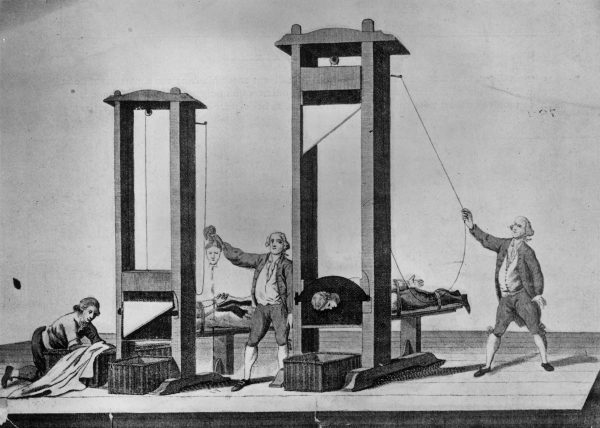
You don’t have to worry about getting a nick or two if you are unfortunate enough to deal with the “National Razor.” More than just giving you a close shave, this razor will chop your head clean off your shoulders as it is actually the Guillotine.
This device for execution gained prominence during the French Revolution and the ensuing Reign of Terror that saw some 15,000 heads separated from their bodies. What most non-French people probably don’t know is that death by guillotine was very much part of the modern era as it still saw action as late as 1977.
The ‘death’ of the guillotine came with the abolition of capital punishment in France in 1981.
JUST SO YOU KNOW: If you thought the national razor was Gillette earlier, it might benefit you to know that the brand isn’t from France and the guy from whom the razor was named after is actually American.
5. Feline Killings

Although the infamous story about a pig being executed for a crime in Falaise may be mostly made up (you can read about it here. See number 10), the cat-killing story from rue Saint-Séverin, Paris is known through Nicolas Contat’s later account, used by historians; it is not independently confirmed in every detail.
Abused apprentices from the printing shop of a certain Jacques Vincent got fed up with the favor shown by their master and his wife towards cats. The apprentices thus conspired to “distress” their masters by imitating the sound of screaming cats on a nightly basis until the masters ordered the cats rounded up.
The apprentices did so in a ritualistic manner, rounding up the cats and beating them half to death. ‘Trials’ were held and the cats were found guilty of witchcraft and were sentenced to death by hanging. The details of the incident were recounted by Nicolas Contat, one of the apprentices involved in the incident.
THE PUNCHLINE: The incident became part of the scholarly work of American historian Robert Darnton entitled, “The Great Cat Massacre and Other Episodes in French Cultural History.” While the apprentices found the incident funny and delightful, Darnton opined in his writings that the actions of the apprentices were a form of worker’s protest.
6. Animal Rescue

The pig execution and the cat massacre may have painted the French as people of interest for the SPCA, but they have much love for animals too as evidenced by this entry.
During the French Revolution, a 1793 measure ended exhibitions of wild animals in the streets of Paris. Confiscated animals were taken alive to the Muséum, and in 1794 they were joined by survivors from the Versailles and Raincy menageries. These transfers helped establish the scientific Ménagerie du Jardin des Plantes, created in 1794.
The place thereafter became known as the Ménagerie du Jardin des Plantes, which is one of the world’s oldest public zoos. Although some may think that animals in cages is still cruel, Jacques-Henri Bernardin de Saint-Pierre, who pushed for the creation of the menagerie, was committed to making the animals feel as close to home as possible.
A TRIP TO THE ZOO: The Ménagerie du Jardin des Plantes located along the Seine in Paris is still very much in operation, which makes it one of the oldest zoos still open today. Even though it doesn’t have many large animals, the zoo currently has a collection of many rare animals.
There are other curious facts about France that you may also not know:
- An old claim said Paris had only one stop sign; the City of Paris says the last one was removed in 2013.
- Posthumous marriage is legally possible in exceptional cases, with presidential authorization for serious reasons and unequivocal evidence of the deceased’s consent.
The facts mentioned above show that there is definitely more to France than just being romantic and fashionable. It shows that the French can get weird too.