French Verb Être: Conjugation and Usage
The French verb être (to be). Learn its uses and conjugations and practise with the exercises in this article!
On this page
Bonus AudioI. How to use êtreII. Être ConjugationIII. Quick Exercise: Fill in the blanks!IV. ConclusionHere are some FAQs about French Verb ÊtreThe French verb être is one of the most important verbs you could learn in French. Être means “to be” and this highly irregular French verb can be found everywhere – in simple daily conversations, idiomatic expressions, written language, and elsewhere – making it a must-learn for anyone who is starting to learn French.
Here in this article, you’ll learn everything you need to know about this verb: how to use être and être conjugation tables.
Bonus Audio
I. How to use être
3 main ways the French verb être (to be) is used
- Être is used with nouns, adjectives, and adverbs to describe the permanent or temporary state of being. Example: Je suis une amoureuse des animaux. (I am an animal lover.)
- Être à expresses possession or belonging. Example: Ce chien est à moi. (This dog is mine.)
- Also to talk about someone’s job or profession. Example: Je suis étudiant. (I am a student.)
Être as an auxiliary verb
- Compound tenses. Être is an auxiliary verb which is used with the past participle of several French verbs to form compound tenses such as the perfect or the past perfect. Example: Je suis allé en France l’année dernière. (I went to France last year.)
- Passive voice. To form the passive tenses in French, être is used, followed by the past participle.
- Present Passive: present tense of être + past participle
- Passé composé passif (perfect passive): perfect tense of être + past participle
- Futur passif (future passive): future tense of être + past participle
- Passé conditionnel passif (past conditional passive): past conditional tense of être + past participle
See also: 200 Most Common French Verbs
II. Être Conjugation
Since être is a highly irregular French verb, the conjugation can be quite tricky. It’s something that you must master usually by memorizing, or with the help of audio drills.
In this part, let’s review the conjugation tables for the French verb être.
Être Conjugated in the Indicative Mood (INDICATIF)
Pin this for later!
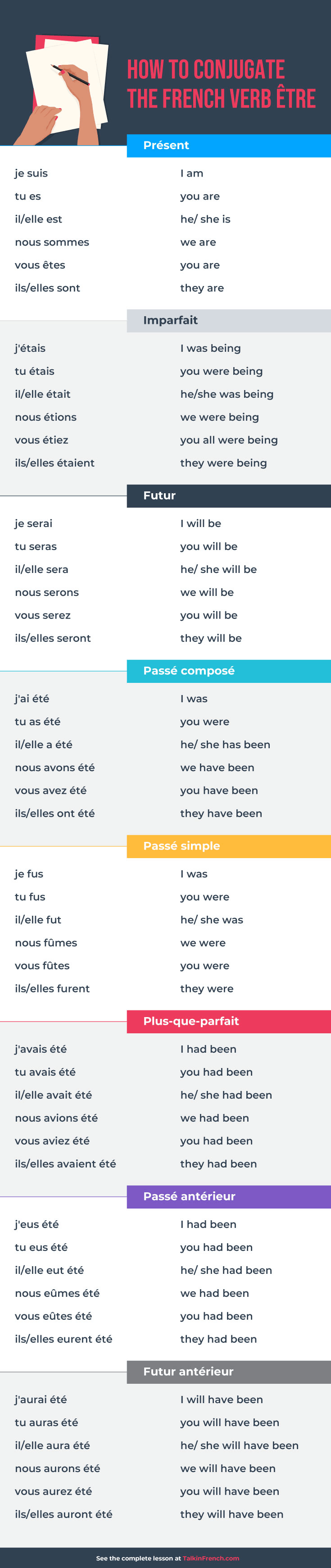
How to conjugate être in the present tense (Présent)
- je suisI am
- tu esyou are
- il/elle esthe/ she is
- nous sommeswe are
- vous êtesyou are
- ils/elles sontthey are
How to conjugate être in the Imparfait
- j’étaisI was
- tu étaisyou were
- il/elle étaithe/she was
- nous étionswe were
- vous étiezyou all were
- ils/elles étaientthey were
Futur
- je seraiI will be
- tu serasyou will be
- il/elle serahe/ she will be
- nous seronswe will be
- vous serezyou will be
- ils/elles serontthey will be
How to conjugate être in passé composé
- j’ai étéI was
- tu as étéyou were
- il/elle a étéhe/ she has been
- nous avons étéwe have been
- vous avez étéyou have been
- ils/elles ont ététhey have been
How to conjugate être in passé simple
- je fusI was
- tu fusyou were
- il/elle futhe/ she was
- nous fûmeswe were
- vous fûtesyou were
- ils/elles furentthey were
être in plus-que-parfait
- j’avais étéI had been
- tu avais étéyou had been
- il/elle avait étéhe/ she had been
- nous avions étéwe had been
- vous aviez étéyou had been
- ils/elles avaient ététhey had been
être in passé antérieur
- j’eus étéI had been
- tu eus étéyou had been
- il/elle eut étéhe/ she had been
- nous eûmes étéwe had been
- vous eûtes étéyou had been
- ils/elles eurent ététhey had been
être in futur antérieur
- j’aurai étéI will have been
- tu auras étéyou will have been
- il/elle aura étéhe/ she will have been
- nous aurons étéwe will have been
- vous aurez étéyou will have been
- ils/elles auront ététhey will have been
Être in the Subjunctive Mood (SUBJONCTIF)
The English meanings below are approximate and depend on the sentence. The imperfect and pluperfect subjunctive are mainly literary forms; modern everyday French usually uses the present or past subjunctive instead. They should not be treated as ordinary conditional forms meaning “would be” or “would have been.”
Présent
- que je soisthat I am
- que tu soisthat you are
- qu’il/elle soitthat he/ she is
- que nous soyonsthat we are
- que vous soyezthat you are
- qu’ils/elles soientthat they are
Imparfait
- que je fussethat I was/were
- que tu fussesthat you were
- qu’il/elle/on fûtthat he/she/one was/were
- que nous fussionsthat we were
- que vous fussiezthat you were
- qu’ils/elles fussentthat they were
Passé
- que j’aie ététhat I have been
- que tu aies ététhat you have been
- qu’il/elle ait ététhat he/she has been
- que nous ayons ététhat we have been
- que vous ayez ététhat you have all been
- qu’ils/elles aient ététhat they have been
Plus-que-parfait
- que j’eusse ététhat I had been
- que tu eusses ététhat you had been
- qu’il/elle eût ététhat he/she had been
- que nous eussions ététhat we had been
- que vous eussiez ététhat you had been
- qu’ils/elles eussent ététhat they had been
Être in the Conditional Mood (CONDITIONNEL)
Présent
- je seraisI would be
- tu seraisyou would be
- il/elle seraithe/she would be
- nous serionswe would be
- vous seriezyou would be
- ils/elles seraientthey would be
Passé (1ère forme)
- j’aurais étéI would have been
- tu aurais étéyou would have been
- il/elle aurait étéhe/she would have been
- nous aurions étéwe would have been
- vous auriez étéyou would have been
- ils/elles auraient ététhey would have been
Passé (2ème forme)
- j’eusse étéI would have been
- tu eusses étéyou would have been
- il/elle eût étéhe/she would have been
- nous eussions étéwe would have been
- vous eussiez étéyou would have been
- ils/elles eussent ététhey would have been
PARTICIPE
Présent
étant
Passé
- masc.sg.: été
- masc.pl.: été
- fém.sg.: été
- fém.pl.: été
PARTICIPE PASSÉ COMPOSÉ
- ayant été
Être Conjugated in the Imperative Mood (IMPÉRATIF)
Présent
- (tu) sois
- (nous) soyons
- (vous) soyez
Passé
- (tu) aie été
- (nous) ayons été
- (vous) ayez été
Être in the Infinitive Mood (INFINITIF)
Présent
être
Passé
avoir été
III. Quick Exercise: Fill in the blanks!
1. Je ____ français (I am French; masculine adjective)
Click to reveal the answer
Je suis français.
2. Tu ____ gentil (You are nice)
Click to reveal the answer
Tu es gentil.
3. Elle ____ jolie (She is cute)
Click to reveal the answer
Elle est jolie.
4. Il _____ sérieux (He is serious)
Click to reveal the answer
Il est sérieux.
5. Nous ____ étudiants (We are students)
Click to reveal the answer
Nous sommes étudiants.
See also: French Verbs Conjugation Quiz
IV. Conclusion
These être conjugation tables will surely make mastering the French verb être easier!
Être is a super-charged, widely-used French verb that you should spend time getting to know along with other most commonly used verbs such as avoir, dire, faire, finir, manger, pouvoir, savoir, venir, voir, and vouloir.
Here are some FAQs about French Verb Être
How do you use être in French?
Être is a verb meaning “to be” in English. Just like the verb “to be,” être is also an extremely versatile and irregular verb. The most basic usage of être is to attribute a trait or describe the state of the subject:
Je suis heureux/heureuse ! (I am happy!)
Nancy est petite. (Nancy is small.)
Nous sommes à la maison. (We are at home.)
Être à can express possession. Être is also used to describe a profession:
Ce chat est à toi, non ? (That cat is yours, isn’t it?)
Elle est médecin. (She’s a doctor.)
What is the présent conjugation for être?
The present tense conjugation for être is as follows:
Je suis (I am)
Tu es (you are)
Il/elle/on est (he/she/it is)
Nous sommes (we are)
Vous êtes (you [plural or formal] are)
Ils/elles sont (they are)
What verbs do you use être with?
The choice of être or avoir as an auxiliary depends on the verb and its construction. In compound tenses such as the passé composé, certain verbs use être: elle est partie (she left). The auxiliaries are not freely interchangeable.
“Dr Mrs P. Vandertramp” is a mnemonic for verbs that commonly use être as an auxiliary when they describe movement or a change of state without a direct object. It is not a list of irregular past participles. Some verbs in the list, including monter, descendre, sortir, rentrer, retourner, and passer, use avoir when they take a direct object. Compare je suis sorti (I went out) and j’ai sorti les clés (I took out the keys). Pronominal verbs also use être, but their past-participle agreement follows specific rules.
Here is the list of Dr Mrs P. Vandertramp verbs:
Devenir (to become): devenu
Revenir (to come back): revenu
Monter (to climb): monté
Rester (to stay): resté
Sortir (to leave): sorti
Passer (to pass): passé
Venir (to come): venu
Aller (to go): allé
Naître (to be born): né
Descendre (to descend): descendu
Entrer (to enter): entré
Rentrer (to return home): rentré
Tomber (to fall): tombé
Retourner (to return): retourné
Arriver (to arrive/come): arrivé
Mourir (to die): mort
Partir (to leave): parti
In the non-pronominal examples below, the past participle agrees with the subject: add -e for a feminine subject and -s for a plural subject. With vous, choose the form according to whether you are addressing one person or several, and their gender.
subject + être (present tense) + past participle (participe passé)
Je suis allé (I went; masculine subject)
Elle est tombée (She fell)
Il est venu (He came)
Nous sommes entrés (We entered; masculine or mixed group)
Ils sont revenus (They came back)