15 Creatures from French Folklore to Haunt Your Dreams Tonight
From mean dwarves to spiky dragons and scary snail monsters, get to know little-known French mythical creatures.
On this page
1. Lutin2. Tarasque3. Nain Rouge4. Lou Carcolh5. Dames Blanches6. Matagot or Mandagot7. Loups-garous/varous8. Peluda9. Feu follet10. Cheval Mallet11. Beast of Gévaudan12. Melusine13. Quinotaur14. Guivre15. GargouilleBONUS CREATURES: Chicheface and BigorneConclusionParanormal creatures are all the rage these days. But you probably have had enough of all those teenage vampires involved in messy love triangles (no offense to the fans!)
If you’re on the lookout for some new level of badassery that you haven’t heard of before, or unsparkling monsters and vile beasts that are not quite mainstream yet… may we interest you in some mythical French creatures?
That’s right. We’ve got an entire squad of French-speaking creepers from French folklore right here waiting for you. But our goal at Talk in French is to spread fun and learning, and we don’t want you cowering in fear under the tables. So, to let you know if you can handle the list, we’ve marked the entries with one to three stars to give you an idea of the featured creature’s scare levels.
Scare factor: 1 star (★) — Meh. Pretty harmless stuff. You might even want to get one as a pet… or a supernatural BFF.
Scare factor: 2 stars (★★) — It manages to raise a few hairs, but nothing to be seriously worried about.
Scare factor: 3 stars (★★★) — Monstrosity to the extreme! This is stuff out of your nightmares, so proceed with caution.
So pull on those blankets over your head and start scrolling because here comes the parade of legendary French creatures from French mythology and folklore!
1. Lutin
Scare Factor: ★
There’s bound to be a similar creature wherever you’re from, so this is definitely not new anymore. Similar creatures in other cultures include dwarves, elves, fairies, gnomes, imps, leprechauns, pixies, sprites, and many other things. But lutins feature in the folklore of Normandy and may be either good or evil.
Just like its Anglo-Saxon counterparts, lutins also play a role in Christmas, as they are the ones who assist Père Noël.
Did you know?
There is a popular French fairy tale called Le Prince Lutin about a handsome prince who turned into a lutin. It was written by Marie Catherine d’Aulnoy and published in 1697.
2. Tarasque
Scare Factor: ★★
This creature of legend was said to hail from the area of Nerluc in Provence and is basically a mish-mash of creature limbs and animal spare parts. It looks like a dragon but has the head of a lion, 3 pairs of short bear-like legs, and a body like an ox which is covered with a turtle’s shell. On top of all that, it also has a scaly tail that ends with a scorpion’s tail. Each part is, of course, designed to maim—or kill, if you’re lucky enough to escape a horrific, traumatized future.
Legend says that the king of Nerluc battled the Tarasque with knights and weapons, but only Saint Martha was able to tame the beast through prayers and hymns. Despite being tamed, the townspeople still killed the creature, but later on regretted doing so after Martha preached to them about Christianity. To make up for what they’ve done, they renamed the town Tarascon, in honor of the slain beast.
Did you know?
The Tarasque inspired the Tarrasque, a legendary monster in the role-playing game Dungeons & Dragons.
3. Nain Rouge
Scare Factor: ★★
The Nain Rouge or literally, the Red Dwarf, is a lutin-like creature in Detroit’s French-influenced folklore. Described in Bobbie Lewis’s 2014 retelling as child-sized with “blazing red eyes and rotten teeth”, this nasty little bugger is not something to be messed with. Red or black fur boots complete his get-up, but don’t let the devilish leer fool you. He’s not merely a trickster, he is also feared as a “harbinger of doom”.
The Nain Rouge is popular in Detroit, Michigan and is a mainstay in local urban legends. It is said that the Nain Rouge may be spotted prior to major catastrophic events and was seen before the Battle of Bloody Run, the fire in 1805, the War of 1812, the 12th Street Riot in 1967, and the snow storm in 1976. Today, there is an annual costumed parade in Detroit meant to drive off the Nain Rouge, the pesky dwarf, for another year.
Did you know?
The Nain Rouge has a beer named in its honor, the Detroit Dwarf altbier. Woodberry Wine also listed a red wine called Nain Rouge Red in its 2017 Michigan catalogue.
4. Lou Carcolh
Scare Factor: ★★★
Is it a snail? Yes.
Is it a serpent? Yes.
Is it a freaky scary monster? HELL YES.
Guys, meet Lou. Not the regular, nice Lou that you know from work. This one is the scariest Lou you could ever come across. And he’s not nice.
He’s an epic snail monster with long tentacles and massive serpent-like body that mostly hides underground until he’s ready to snap at you and paralyze you with his hairy, slimy limbs. Then he eats you. With his huge gaping mouth.
And oh, by long tentacles, we meant that in Vilnius University’s Map of Mythical Creatures in Europe, they can extend for miles and there’s really no hope of escape when you come across Lou Carcolh. So unless you’re a fighting ninja swordsman with expert monster-fighting abilities, there is nothing left for you to do but cry and say a little prayer before you officially become slime-covered snail food – swallowed whole with clothes and all.
This serpent-mollusk hybrid is said to live in the underground caverns of southwest France and carries a shell on its back, just like a normal snail. But it’s far from normal. And it’s about to take over your nightmares, so we might as well stop talking about him now.
*shudder*
5. Dames Blanches
Scare Factor: ★★
Dames Blanches literally mean “White Ladies” and there’s probably a version of this where you’re from. Some consider them ghosts while others classify them as female supernatural beings or fae folk. In France, the Dames Blanches are popular in the regions of Lorraine and Normandy and were said to appear in Occitan-speaking regions, the Pyrenees mountains and elsewhere.
They are said to lurk near caverns, ravines, bridges and other narrow places where they can attract the attention of people passing through. They are generally not too mean or evil, but they could still do some damage if you don’t play up to their whims and demands. Kinda like female bandits, but the supernatural kind.
6. Matagot or Mandagot
Scare Factor: ★
This mythical creature was passed along through stories across generations in southern France, and is basically a spirit in animal form. Its favourite forms include black cat, dog, cow, fox or even rat.
While considered to be evil, other accounts say that matagots or mandagots can be actually helpful and could even bring wealth to a home if they are lured with fresh and plump chicken and fed the first mouthful of each meal. There are plenty of versions on How To Care for Your Matagot, but the bottom line is, if you get something out of it, expect to give something in return, too. He’s all about quid pro quo.
7. Loups-garous/varous
Scare Factor: ★★
By now werewolves have probably lost their appeal to you, with all the new breeds of werewolves popping up on TV and literature. I mean, werewolves were scary, like, the first ten times you heard of them, right? But don’t dismiss werewolves just yet because you have yet to meet…. the French werewolves!
Aside from the likelihood that the French loups-garous probably have French names such as Antoine, Guillaume or Benoît in their human forms, there are also other major differences from how the other western cultures portray werewolves. For one, in some versions, the loups-garous do not have to wait until the full moon to transform into wolves… they can do so at will. So that’s some major shape-shifting abilities, eh?
In these versions, the loups-garous are also fully aware of what transpires when they’re in wolf form, so they don’t turn into raving wild beasts. They retain their intelligence but their senses and abilities are enhanced—making them so much more difficult to destroy than the average werewolves.
8. Peluda
Scare Factor: ★★★
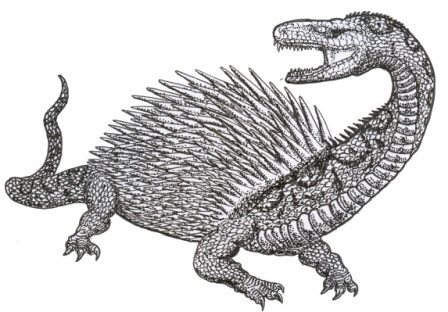
Peluda is Spanish for “hairy” or “shaggy”; the creature’s French name, La Velue, means “the hairy one”. The Peluda, like the Tarasque, is also a mix-and-match assortment of beast parts that all come together to produce one hell of a monster mix.
Pop quiz!
Question: Which features does the Peluda have in Borges’s retelling:
- Deadly spines
- Snake’s head
- Tortoise feet
- Serpent tail
- All of the above
Answer: 5! All of the above.
The result of all these mixed and matched body parts gives an overall look of a stinger-tipped green-colored dragon, which was said to have terrorized La Ferté-Bernard, France during medieval times.
In Borges’s retelling, its super abilities include flames that could destroy crops, deadly spines, and overall invulnerability except for its tail. It could also create floods when it hid in the waters of the Huisne and inflict lethal strikes with its tail. In short, it’s basically an all-in-one military superweapon-slash-strike team.
Did you know?
In Borges’s retelling, the Peluda was not among the animals who were saved inside Noah’s Ark. But it still survived the Great Flood. Afterwards, it went on in a fit of rampage across the countryside, killing everything in its path.
9. Feu follet
Scare Factor: ★
You have most likely heard of this by the names will-o’-the-wisp or jack-o’-lantern, but the French call it feu follet.
The feu follet is some sort of atmospheric ghost light which appears in shades of faint bluish glow or sometimes even yellowish, reddish, or greenish. It appears suspended in air, sometimes flickering and often appears just briefly at night above cemeteries, swamps, or bogs. Aside from their ghostly light, feux follets are generally harmless. But beware, as these wisps are said to be spirits of the dead or supernatural beings which, when followed, will lead to your death.
10. Cheval Mallet
Scare Factor: ★
Cheval means “horse”; Mallet is part of the creature’s name. And yes, it is indeed evil, but it’s also quite fabulous. This evil but fabulous horse appeared in French folklore specifically around the French areas of Vendée, Poitou, and Pays de Retz.
The horse’s modus operandi is to appear in the middle of the night and hang out in roads to lure weary travelers. When the exhausted traveler sees the fabulous horse all saddled and bridled, and he decides to take a ride, the poor ill-advised traveler would most likely never be seen again.
The moral of this legend is simple enough: never ride a strange beautiful horse that you see on the road.
11. Beast of Gévaudan
Scare Factor: ★★★
You know what earns this beast a three-star rating? It’s the scary fact that this was actually recorded in history. That’s right. There were real attacks attributed to a mysterious man-eating beast that wreaked havoc on the former province of Gévaudan or roughly what is presently known as Lozère and part of Haute-Loire. The beast’s exact identity remains uncertain.
Between 1764 and 1767, there was a series of reported attacks. Historical estimates put the death toll at over a hundred, though counts vary by source. Some of the victims were also partly eaten. Yikes. The scare caused by this foul beast led to a royal intervention, with Louis XV–the king himself–sending out his professional hunters to put an end to the killings.
12. Melusine
Scare Factor: ★
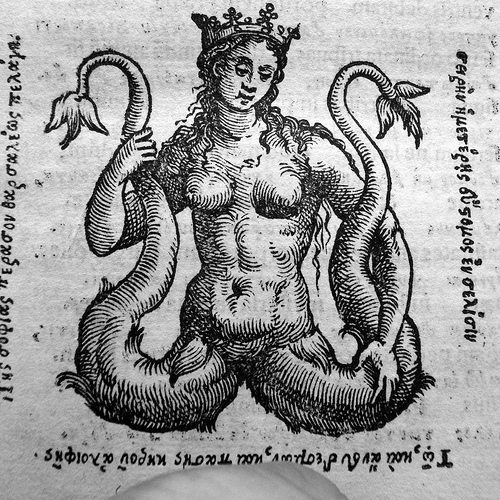
The Melusine is a feminine spirit that seems to resemble a mermaid and she is popular in the folklore of western France, especially Poitou. She lives in rivers and springs and other fresh waters, and is sometimes featured with wings or one or two tails that could either be a serpent’s or a fish tail.
Did you know?
The twin-tailed siren in the logo of the famous coffee brand Starbucks is often compared to the Melusine.
13. Quinotaur
Scare Factor: ★★
The name Quinotaur has been interpreted as “bull with five horns”, though its exact meaning is disputed. This mythical sea creature appears in the Chronicles of Fredegar, a 7th-century record. In the chronicle, a sea beast resembling a quinotaur assaults the wife of the Frankish king Chlodio. She then bears Merovech, after whom the Merovingian kings were named—but the text leaves his father uncertain: either the beast or Chlodio.
14. Guivre
Scare Factor: ★★
Another dragon-serpent type of monster, this creature has the head of a dragon and venomous breath. It is said to have wandered the Medieval French countryside. It liked to live near damp places such as forests, lakes, and small natural pools. The Guivre is somewhat similar to wyverns.
Did you know?
The Guivre is said to be scared and quite uncomfortable with naked humans. Despite being very aggressive creatures, they blush and look away when there are nude people around. So remember, when you fight a Guivre – it’s naked time!
15. Gargouille
Scare Factor: ★★
This legendary water-spouting dragon with four legs and bat-like wings is said to have terrorized the Seine River. But Saint Romain, the bishop of Rouen, saved the day by taming the gargouille through the sign of the cross. In one version of the legend, the monster’s neck and head were then mounted on the town’s cathedral as a way of displaying God’s power. The story links the creature to the gargoyles carved on buildings as drainpipes (because gargouilles spout water, too). It offers a legendary explanation for these architectural features.
BONUS CREATURES: Chicheface and Bigorne
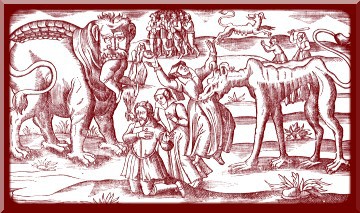
Now I’m pretty sure you haven’t heard of these two ever before. The Chicheface (also known as Chichevache, “skinny cow”) is a long, gaunt creature. It is super thin; barely skin and bones.
Its counterpart, the Bigorne, is a bloated creature with a human-like face, scales on its back, a smooth belly, clawed forepaws, webbed hindpaws, and tufted tail. It has some similarities with a Tarasque in the looks department, but it’s a different creature all on its own.
Now the thing about these two is the satire behind them. It is said that the Chicheface is thin because it feeds on submissive wives. The Bigorne, on the other hand, is massive because it feeds on husbands who are obedient to their wives. So since very few wives submit to their husbands, the Chicheface lacks food and is thin, and the Bigorne is fat because there is plenty of food to find.
It sure tells you some fascinating insights, doesn’t it?
Conclusion
So there you go, 15 mythical creatures from France. Which one is your favorite? If there are more creatures from French folklore or French mythology that we missed in this article, please don’t hesitate to leave a message.
For related articles, you can also check out:
Want more French culture articles? Check out the culture section of this blog.