How to Write a Letter in French: A Simple Guide
Learn how to write a letter in French with this simple and concise guide. Get tips and examples and learn how to write personal letters and formal letters.
On this page
I. Greetings/ Salutations for French LettersII. How to close your letterIII. Some example French lettersIV. Additional Tips in Letter-WritingBonus: How to write an email in FrenchConclusionHere are some FAQs about Letters in FrenchWriting letters can be stressful for a lot of people… and even more so when you have to do it in French! Today we will make writing letters in French a lot easier with this simple guide on how to write a letter in French.
In this lesson, you’ll learn the words, phrases, and expressions for starting and ending your letter plus tips and examples.
You get an extra lesson on how to write emails in French, too!
I. Greetings/ Salutations for French Letters
To start writing a letter in French, you need the proper salutation and the correct title of the person you are writing to.
Salutations for French Personal Letters
For personal correspondence, you can choose between the following scenarios and salutations.
If you know the person, you can use the following:
| Cher Monsieur | Dear Sir |
| Cher Monsieur ______ | Dear Mr. ______ |
| Chère Madame | Dear Ma’am |
| Chère Madame ______ | Dear Mrs. _______ |
| Chère Mademoiselle | Dear Miss |
| Chers amis | Dear friends |
| Mon cher Pierre | My dear Pierre |
| Ma très chère Louise | My dearest Louise |
For personal correspondence where you do not know the person you are writing to, you can choose from the following:
| Monsieur | Sir |
| Monsieur ______ | Mr. ______ |
| Madame | Ma’am |
| Madame ______ | Mrs. _______ |
| Mademoiselle | Miss |
| Messieurs | Sirs |
Salutations for French Formal Letters
For business letters, salutations are very formal and include the recipient’s title as needed. You may use the following salutations:
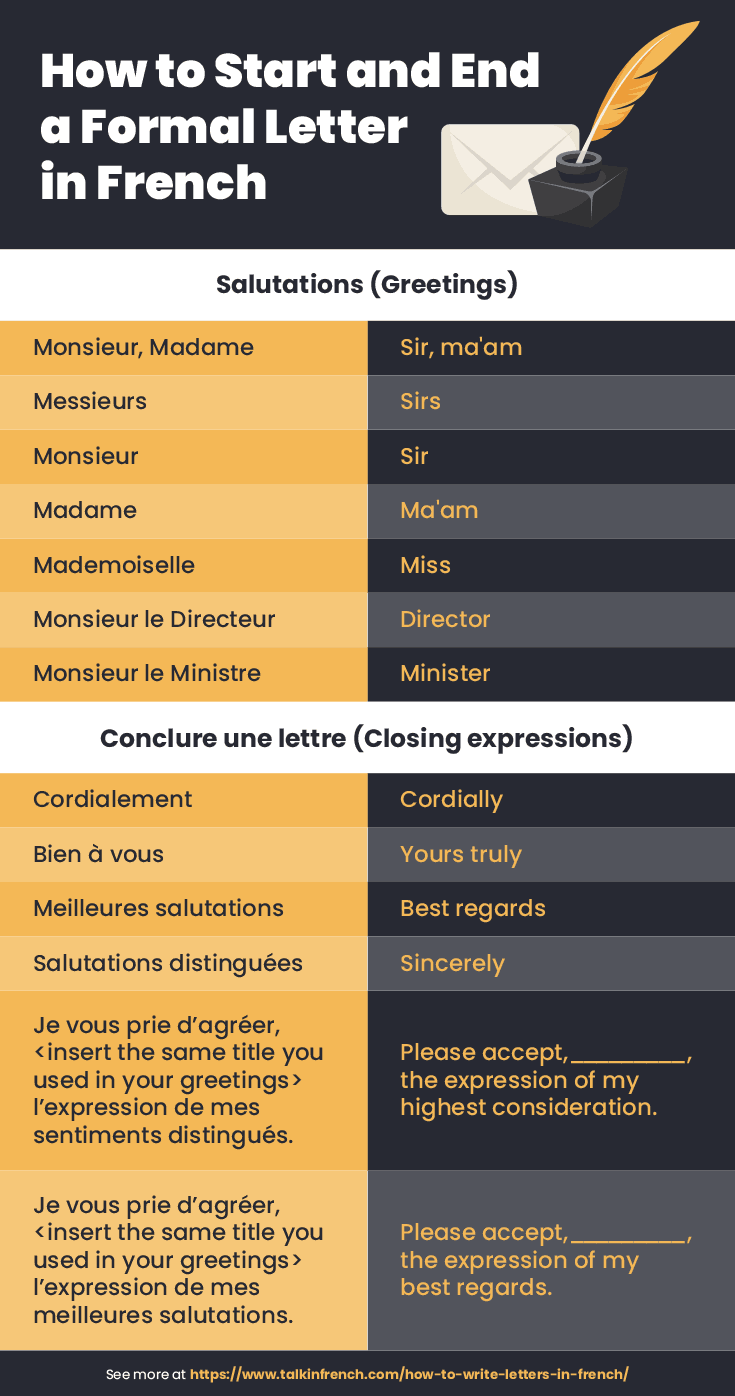
| Monsieur, Madame | Sir, ma’am |
| Messieurs | Sirs |
| Monsieur | Sir |
| Madame | Ma’am |
| Mademoiselle | Miss |
| Monsieur le Directeur | Director |
| Monsieur le Ministre | Minister |
Quick reminder
Take note of proper spacing when writing punctuation in French. When writing a sentence with a question mark or an exclamation point, there should be a space before and after it. For example: Bonjour ! Ça va ?
The same applies to writing colons and semi-colons, as well as quotation marks.
II. How to close your letter
Just like the salutations, you will also need to use the correct closing at the end of your letter.
Closing Expressions for French Personal letters
For personal letters to acquaintances or friends that still require a level of formality, you may end them using the following closing expressions:
| Je vous envoie mes amicales pensées. | Works like “Best wishes” but literally means “sending my friendly thoughts to you” |
| Recevez, je vous prie, mes meilleures amitiés. | Yours sincerely. |
| Je vous adresse mon très amical souvenir. | Kindest regards. |
| Cordialement (à vous) | Cordially (yours) |
| Votre ami dévoué(e) | Your devoted friend |
| Chaleureusement | With warm regards; Warmly |
| Bien amicalement | Sincerely; In friendship |
| Amitiés | Best wishes, All the best |
| Bien à vous, Bien à toi | Best wishes |
| À bientôt ! | See you soon! |
| Affectueusement | Fondly |
| Affectueuses pensées | With fond thoughts |
Please note that the translations are not exactly the same, but they more or less express the same thought.
For informal letters to close friends and family, you may be very liberal in showing your fondness to the person by using the following informal closing:
- BisousKisses
- Grosses bises, Gros bisous, Je t’embrasse (bien fort)Big kisses
- BizouxKisses
Take note that the above closing expressions are similar to saying “hugs and kisses” or “XOXO” in English. You simply cannot use them to close a letter to, let’s say, your boss or the hiring manager in the job you’re eyeing.
See also: French text slang and instant messaging shortcuts
Closing Expressions for French Formal or Business Letters
| Cordialement* | Cordially |
| Bien à vous* | Yours truly |
| Meilleures salutations | Best regards |
| Salutations distinguées | Sincerely |
| Je vous prie d’agréer, <insert the same title you used in your greetings> l’expression de mes sentiments distingués. | Please accept,______, the expression of my highest consideration. |
| Je vous prie d’agréer, <insert the same title you used in your greetings> l’expression de mes meilleures salutations. | Please accept,______ , the expression of my best regards. |
*These two are not too formal, and could be used for less formal situations.
Again, please take note that the above translations are more or less the equivalent expressions in English.
Pin this image for later!
III. Some example French letters

Let’s take a look at two sample letters below. The first one is a personal letter and the second is a business letter.
Example 1: Personal Letter
Chère Mademoiselle,
C’est avec plaisir que je vous écris. L’envie me prend soudainement de vous conter l’une de mes nombreuses aventures…
Je vous envoie mes bien amicales pensées. À bientôt !
Dear Miss,
It is with pleasure that I’m writing to you. The urge suddenly takes me to tell you of one of my many adventures …
Best wishes. See you soon!
Example 2: Business Letter
Monsieur,
Je me permets de vous écrire concernant l’offre de poste…
Je vous prie d’agréer, Monsieur, l’expression de mes sentiments distingués.
Sir,
Allow me to write you about the job offer…
Please accept, sir, the expression of my highest consideration.
IV. Additional Tips in Letter-Writing
Of course, starting and ending a letter written in French is just the tip of the iceberg. Here are more tips in writing letters in French.
- In writing formal letters, always use “vous” and never “tu”.
- For personal letters, you may use “tu” but only with people you are on “tu” terms with.
- A properly worded and formatted letter will make your content sound credible. So take note of the correct form.
- Write the return address at the top left of the page. Start with your name followed by your organization (for business letters) and then your address.
- The recipient’s address will be placed below it to the right side.
- Under it, place the town or city where the letter is being written, followed by the date.
See also: The ultimate guide to using tu vs. vous in French
Bonus: How to write an email in French
Let’s face it, writing an email in French is another hurdle you must clear. Whether you’re writing an email to your boss, a colleague, or someone you barely know, you gotta make sure everything’s in place before you hit the send button.
No worries, because we’re going to discuss how to write emails here, too!
- Always start your email with a greeting such as “bonjour” or “bonsoir”. Unlike letters, you don’t need to use Cher / Chère, but if you know the person you’re writing to and feel comfortable, go ahead and use it.
- You can say, “Bonjour Monsieur / Madame” when emailing someone you’re not yet acquainted with.
- If you know the job title of the person you’re writing to, you can include it in your salutation. For example, Monsieur le Directeur (Mr. Director) or Madame la Directrice (Madam Director).
- When emailing someone you are on informal terms with, you can simply start your email with “Salut + the name” followed by some pleasantries. For example: Salut, Marianne ! J’espère que tu vas bien (Hello, Marianne! I hope you’re doing well.)
- Be mindful of the correct usage of tu and vous.
Did you know?
La nétiquette refers to the rules of good manners when communicating online, especially by email.
How to end formal emails
Like in English, there is also a set of phrases and expressions commonly used when signing off formal emails. Aside from the usual “merci” or “merci beaucoup”, here are some ways to sign off an email in French:
| Bien cordialement | kind regards |
| Cordialement | Cordially, used like “best regards” |
| Bien à vous | Yours truly, yours sincerely |
| Merci par avance | Thanks in advance |
| Merci par avance pour votre compréhension | Thanks in advance for your understanding |
| Je reste à votre disposition pour tout renseignement complémentaire | Feel free to contact me for any further information |
Conclusion
Letter-writing is still a necessary skill despite the many new forms of communication available today. I hope this short guide will help solve your woes on how to write letters in French. Hopefully, you learned something about writing emails in French, too!
Here are some FAQs about Letters in French
How to close a letter in French
1. Je vous envoie mes amicales pensées. – This means “best wishes” but the literal translation is “sending my friendly thoughts to you.”
2. Recevez, je vous prie, mes meilleures amitiés, – Yours sincerely,
3. “Meilleures salutations,” – Best regards,
4. À bientôt ! – See you soon
5. Bisous – Kisses
How to address a letter in French
To address a letter in French, the first line will be the recipient’s full name. Do not forget to add Monsieur, Madame or Mademoiselle before the name.
The second line will be the recipient’s street address (number first, then the street name). The third line will be the postal code followed by the city or town. French addresses do not include a state name.
How to write a formal letter in French
Sender
First is to write down the sender’s details at the top left of the letter. Start with your name or a company name and include your address, with the country name in French under the postal code.
Addressee
Second is the addressee information. This is where you will write the name and address of the recipient. Remember to write place names with capital letters.
Subject
In French, instead of writing ‘Subject’, you write ‘Objet’ or ‘Concerne’. This is where you indicate the purpose of the letter.
Place and date
On the right side of the letter, below the addressee’s details, write down the place and date and separate them with a comma. The name of the month is written with lowercase letters.
Example:
Los Angeles, le 1er février 2021
Miami, le 5 juin 2020
Salutation
French formal letter salutations do not mention the name of the addressee. You will only write, ‘Monsieur’ or ‘Madame’. Do not forget to end the salutation with a comma.
Example:
Monsieur,
Message
The body of your letter consists of three parts:
Opening paragraph
The reason why you are writing the letter
Closing paragraph
Your Signature
Sign your letter above your printed name on the right hand side. Also, add your job position or department in the line below your full name.